

Applications should differentiate above the transaction layer.
Modern software systems repeatedly rebuild the same transactional infrastructure. Every new application reconstructs CRUD endpoints, repository access, JSON serialization, pagination, filtering, sorting, relationship handling, authorization, validation, standard errors, cache validation, logging, metrics, and connection pooling.
These components are essential, but they rarely represent the unique value of the application itself.
The thesis behind Cleave is simple:
Transactional repository access should become infrastructure.
Where applications differentiate
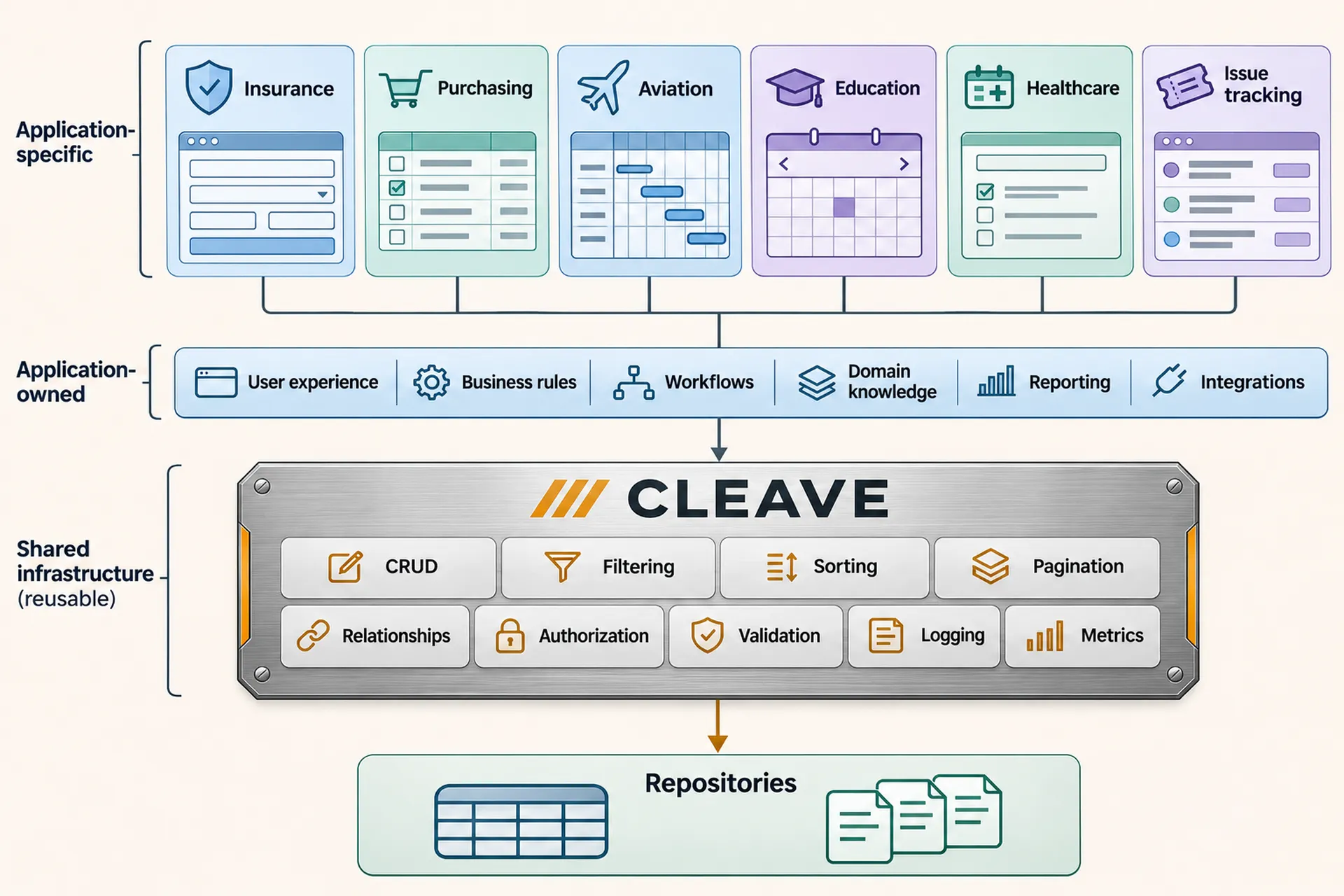
Applications compete through user experience, workflow, business rules, domain knowledge, visual design, reporting, and integration with the rest of the business.
The underlying transactional mechanics are far more repetitive:
Create, retrieve, update, delete, filter, sort, paginate, relate, authorize, validate, log, and measure.
The semantics change. The mechanics rarely do.
An insurance policy, purchase order, aircraft part, university course, medical appointment, and issue tracker ticket may carry very different business meaning. To the repository, they are still rows, documents, keys, relationships, indexes, and transactions.
Why this should be a supplier
Modern systems already depend on specialist suppliers.
The categories and suppliers are familiar:
- PostgreSQL, MySQL, Oracle, SQL Server, MongoDB, and Redis manage data;
- Auth0, Okta, Keycloak, Amazon Cognito, and Microsoft Entra ID issue identity;
- Stripe, Adyen, Braintree, and PayPal handle payments;
- Kafka, RabbitMQ, Amazon SQS, and Google Pub/Sub move messages;
- Datadog, Splunk, Grafana, ELK, and Papertrail collect operational signals.
Cleave does not replace any of these. It sits orthogonally to them, occupying a layer that exists today mostly as duplicated application code:
secure, high-performance transactional repository access.
What Cleave replaces
Cleave replaces repeated implementation work between applications and repositories.
Instead of maintaining a controller, serializer, and authorization path for each resource, a team configures Cleave and calls its shared interface. A new screen can use the same filtering and pagination behavior as the rest of the application without another set of handlers to write and test.
The value is not that applications no longer need backend engineers. The value is that backend engineers can focus on domain-specific systems instead of rebuilding generic transactional infrastructure.
Not another framework
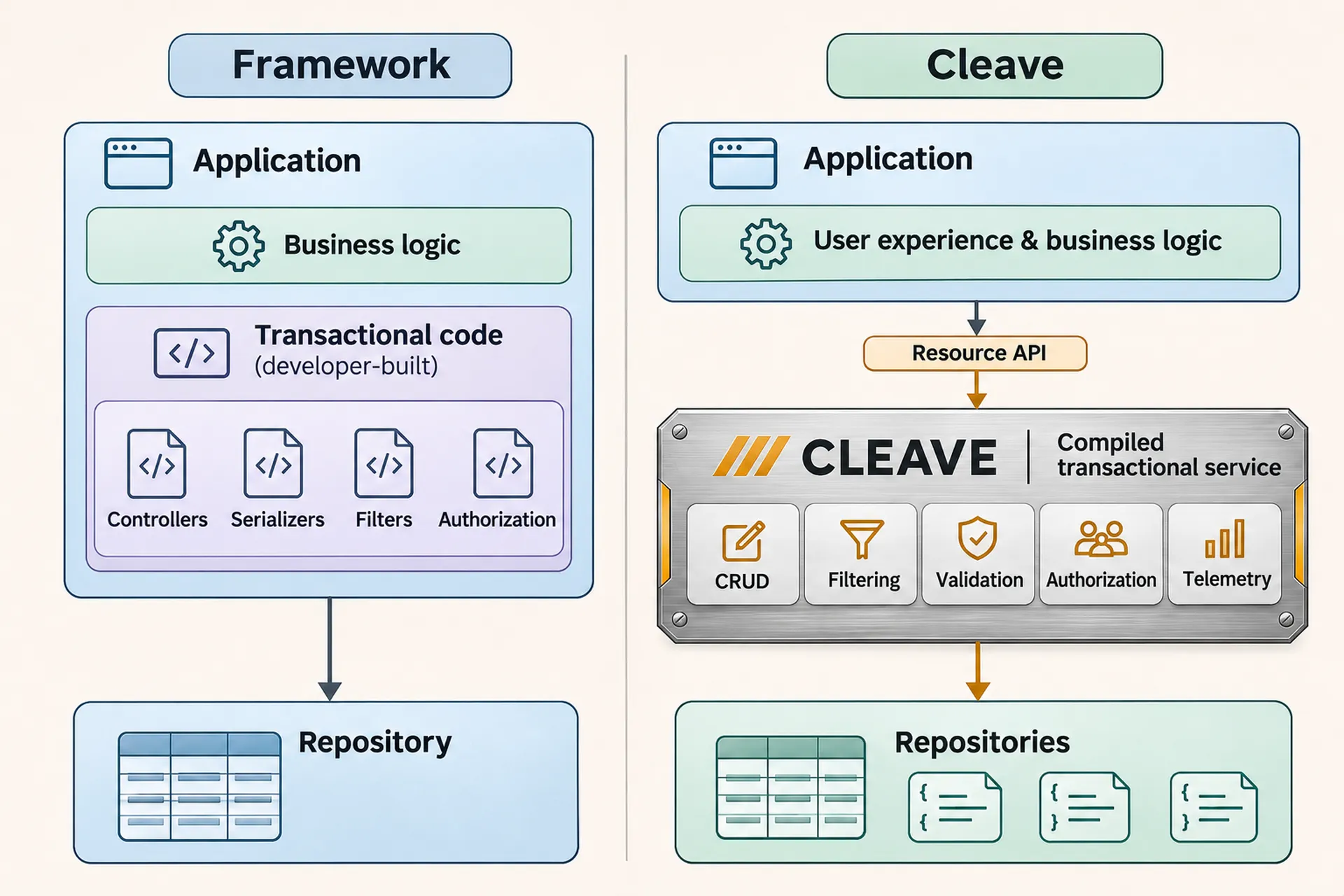
Frameworks help teams write transactional infrastructure.
Cleave removes the need to write much of that infrastructure in the first place.
That distinction matters. Frameworks generate or host application code. Cleave executes standardized transactional behavior as a compiled service. Your application code still decides how an order is approved, a payment is coordinated, or a customer is notified.
Boundaries matter
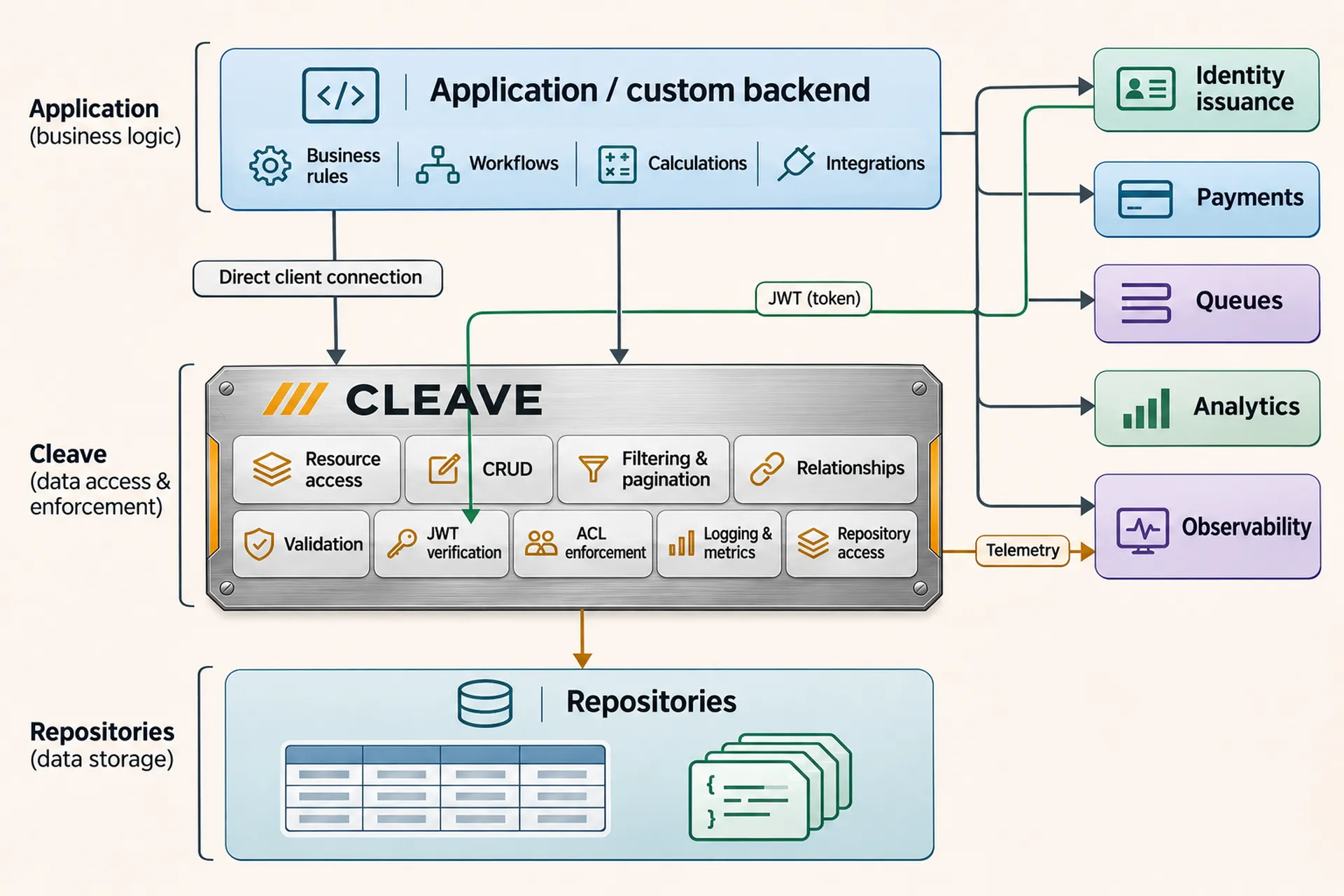
The thesis only works if Cleave keeps a sharp boundary.
Cleave should be treated like a specialized infrastructure supplier, not a product that absorbs every adjacent responsibility. Identity, payments, queues, workflows, analytics, observability, and domain-specific computation already have specialist suppliers or belong in application code.
The detailed product boundary, request pipeline, repository model, and authorization model belong in Architecture and Boundary.
Final position
Cleave is a compiled transactional repository service that replaces repetitive application plumbing with a standardized, secure, high-performance resource interface.
It is not backendless. It is not a framework. It is not an ORM. It is not an application platform.
It is a missing infrastructure supplier for transactional repository access.