

Transactional infrastructure for OLTP applications
Stop writing transactional plumbing.
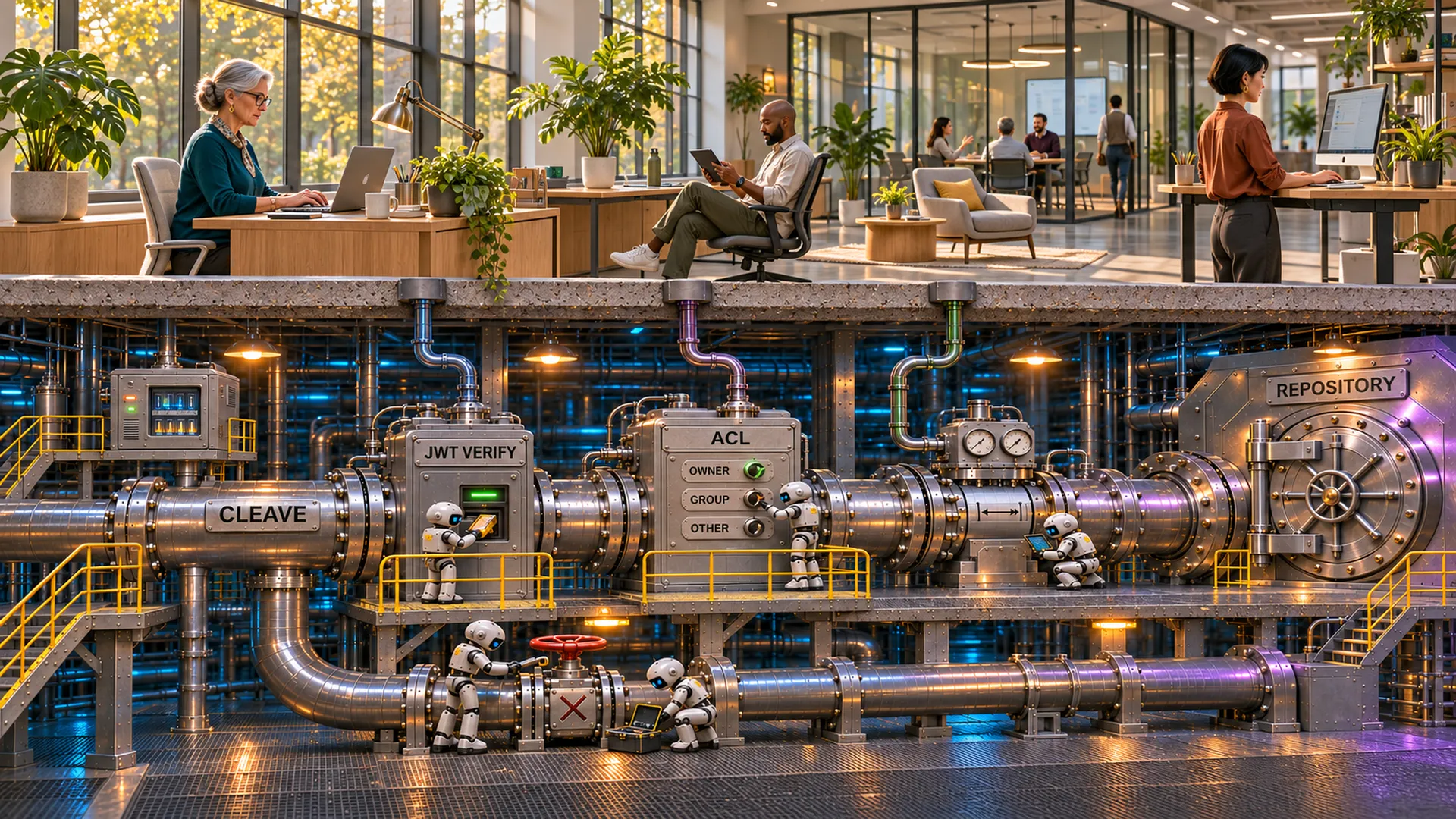
Cleave is an online transactional repository service (OLTRS) that handles the repetitive repository-facing layer: CRUD, filtering, pagination, relationships, validation, JWT verification, ACLs, logging, metrics, and repository access.
cleave /kliːv/
verb
- To split, divide, or separate.
- To adhere, join, or hold firmly together.
Cleave apart: Parse requests into native repository operations.
Cleave together: Assemble results into structured resources and relationships.
Two Old English verbs, one name. The name and the daemon →
Applications should differentiate above the transaction layer.
Applications differ in their user experience, workflows, and business rules. Much of the repository-facing work beneath them is the same. Cleave provides that shared layer as infrastructure, giving teams more time for the parts specific to their application.

The transactional plumbing for OLTP applications.
Cleave handles the resource requests, validation, authorization, and repository operations that underpin OLTP applications. Call it directly from a client, use it behind a custom backend, or combine both approaches while keeping business logic in your application services.

Security by bounded access, not scattered endpoint code.
Cleave treats security as part of the transactional boundary: structured requests, shared repository operation generation, bearer-token verification, Unix-style record permissions, forbidden collections, IP allow-lists, TLS options, size limits, and request timeouts.
Your repository schema remains the source of truth.
Cleave brings a shared resource interface directly to your repositories, without a separate schema-mapping or API-generation step. Resources, filters, relationships, and navigation follow a common contract instead of a collection of application-specific calls.
Next
Start with the transactional layer.
Read the first docs, review the deployment shape, or download a build when one is available for your environment.